


Global distribution teams sourcing juice blenders must navigate health trends, smart features, sustainability demands, private label growth, and regional compliance. This article reviews key supplier trends and highlights the capabilities needed for success. It emphasizes independent research and development, in-house molds, certifications such as CE, CB, GS, RoHS, and ISO9001:2015, and flexible OEM, ODM, and CKD services. A spotlight on Jiangmen Taifai Technology Co.,Ltd, known as TAIFAI, illustrates how a professional kitchen appliance manufacturer can support distributors. Founded in 2007 in Jiangmen City, Guangdong Province, China, TAIFAI is a high-tech enterprise with independent research and development, production, and sales. Its main products include electric blender, juicer, citrus juicer, hand mixer, hand blender, stand mixer, coffee grinder, chopper, and food processor. TAIFAI has 50 patents, 50 own molds, and produces according to ISO9001:2015 standards. Many products carry CE, CB, GS, and RoHS certification with strong design, good performance, multi-functional features, and reasonable price. For distribution teams, the article provides a checklist covering certifications, motor specifications, packaging, MOQ, lead times, patent protection, and after-sales support. It also outlines regional preferences across North America, Europe, the Middle East, Southeast Asia, Latin America, and Australia. The conclusion stresses that long-term success depends on suppliers that combine innovation, compliance, and scalable production. TAIFAI’s integrated design, research, development, production, sales, and service model positions it as a relevant partner for global juice blender distribution.
Global distribution teams face a rapidly shifting landscape when sourcing juice blenders. Consumer demand for fresh, nutrient-rich beverages has turned the juice blender from a niche kitchen gadget into a mainstream appliance. For distributors, importers, and retail buying groups, the supplier selection process now involves far more than price negotiation. It requires an understanding of design trends, certification requirements, manufacturing flexibility, and long-term supply chain reliability. This article examines the major trends shaping juice blender sourcing and explains how a capable manufacturing partner such as Jiangmen Taifai Technology Co.,Ltd, known as TAIFAI, can support global distribution teams in meeting those challenges.
Several forces are converging to reshape the juice blender category. Health-conscious consumers are preparing more smoothies, cold-pressed juices, and plant-based blends at home. Retailers are expanding their small appliance aisles and private label programs. E-commerce platforms are driving demand for compact, visually appealing, and easy-to-ship models. At the same time, regulatory frameworks for electrical safety, food contact materials, and energy performance continue to tighten across regions. Distribution teams must therefore work with suppliers that can combine innovation, compliance, and scalable production.
undefined
The global juice blender market is also becoming more fragmented. No single design dominates. Instead, distributors need a portfolio that includes personal blenders, full-size countertop models, citrus juicers, and multi-function kitchen systems. This diversity puts pressure on suppliers to offer flexible manufacturing, rapid prototyping, and reliable quality control. Companies that can support OEM, ODM, and CKD models are better positioned to serve different market segments without sacrificing speed or consistency.
Health and wellness remain the strongest demand drivers. Consumers want blenders that preserve nutrients, handle fibrous ingredients, and simplify cleanup. Suppliers are responding with high-torque motors, titanium-coated blades, vacuum blending technology, and cold-press extraction systems. For distribution teams, these features translate into premium price points and stronger differentiation. A supplier with independent research and development capabilities can help distributors introduce models that align with local health trends, from sports nutrition to baby food preparation.
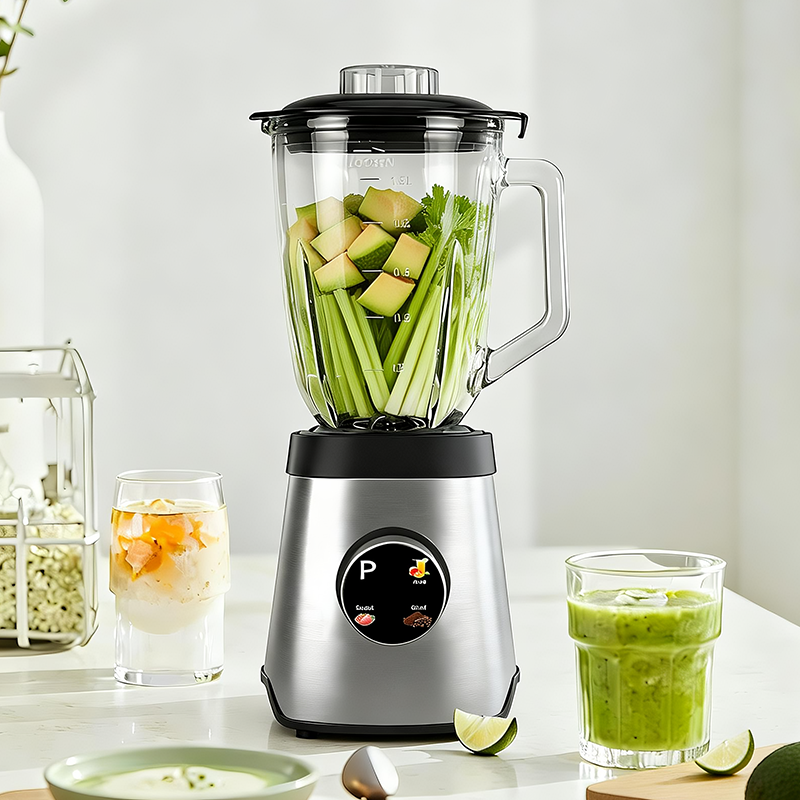
Smart appliances are moving into the juice blender category. Bluetooth connectivity, app-guided recipes, automatic programs, and touch interfaces are appearing in mid-range and high-end models. While not every market requires smart features, they can elevate brand perception and support higher margins. Distribution teams should evaluate whether a supplier has the engineering depth to integrate electronics without compromising durability or safety. TAIFAI, for example, operates as a high-tech enterprise with capabilities in independent research and development, production, and sales, which allows it to support increasingly sophisticated product requirements.
Sustainability is no longer a niche concern. Distributors face pressure from retailers and consumers to offer blenders made with recyclable materials, reduced packaging, and energy-efficient motors. BPA-free Tritan jars, borosilicate glass, stainless steel housings, and replaceable components are becoming common requests. Suppliers that manage their own molds can more easily adopt new materials and reduce waste during production. TAIFAI owns 50 molds and has been approved for dozens of patents, giving it a strong foundation for sustainable design iterations and custom tooling.
Private label programs are expanding rapidly. Retail chains, e-commerce brands, and specialty kitchen stores want unique colors, logos, packaging, and feature sets. This trend favors suppliers that offer OEM, ODM, and CKD support. OEM allows distributors to specify exact designs, ODM provides ready-to-brand platforms, and CKD enables local assembly or regional customization. A supplier with in-house molds, engineering, and quality systems can move from concept to container faster. TAIFAI supports OEM, ODM, and CKD, making it a versatile partner for global distribution teams that serve multiple channels.
Recent years have highlighted the importance of supply chain resilience. Distributors are diversifying suppliers, increasing safety stock, and demanding greater transparency. They also need products that meet regional certifications such as CE, CB, GS, and RoHS. TAIFAI produces goods according to ISO9001:2015 standards and insists on strict management of production operation and quality. Its products have CE, CB, GS, and RoHS certification, which helps distribution teams reduce compliance risk when entering European and other regulated markets.
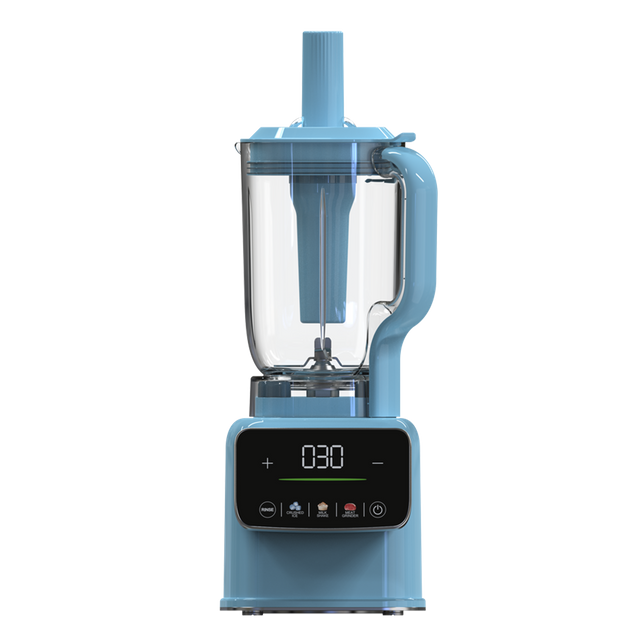
When evaluating juice blender suppliers, global distribution teams should look beyond unit price. The following capabilities often determine long-term success:
Jiangmen Taifai Technology Co.,Ltd is located in China, a flourishing home appliances manufacturing base in Jiangmen City, Guangdong Province. Founded in 2007, the company is a high-tech enterprise with capabilities and services of independent research and development, production, and sales. Its main products include electric blender, juicer, citrus juicer, hand mixer, hand blender, stand mixer, coffee grinder, chopper, and food processor. This broad portfolio allows distribution teams to source multiple kitchen appliance categories from a single qualified supplier.
TAIFAI is focusing on the manufacturing and service of kitchen electric appliances. It is a professional kitchen appliances manufacturer with excellent scale and technology in China. The company is a high-quality kitchen electric appliances provider integrating design, research, development, production, sales, and service. For global distribution teams, this integration means fewer handoffs, clearer accountability, and faster problem resolution.
TAIFAI supports OEM, ODM, and CKD. It has 50 patents and 50 own molds. Its products have been approved for dozens of patents, and production follows ISO9001:2015 standards. A variety of products have CE, CB, GS, and RoHS certification with fantastic design, good performance, multi-functional features, and reasonable price. These attributes are particularly valuable for distributors that need to balance innovation, compliance, and margin.
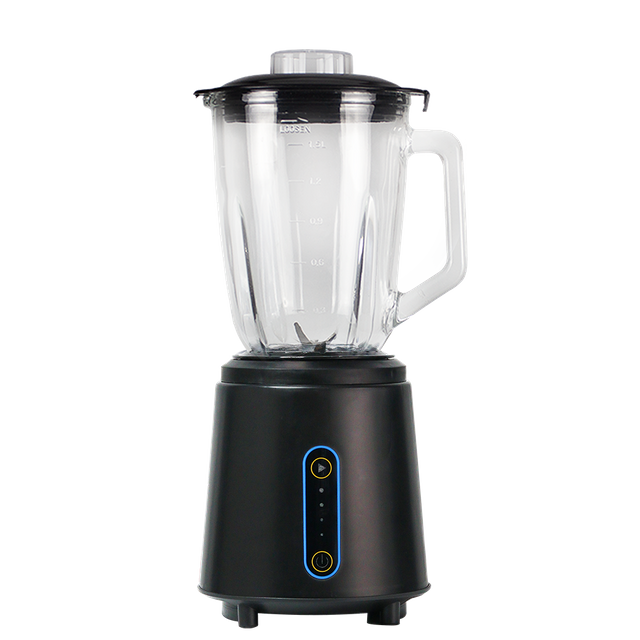
Company honors reflect TAIFAI’s commitment to quality and scale. As a professional kitchen appliances manufacturer, it has built a reputation for reliable manufacturing and responsive service. Distribution teams that prioritize long-term partnerships often seek suppliers with this combination of technical depth, certification coverage, and production experience.
Juice blender preferences vary by region. Distribution teams should align product specifications with local voltage, plug types, safety standards, and consumer habits. The table below summarizes common considerations.
| Region | Key Preferences | Common Compliance |
|---|---|---|
| North America | Large capacity, powerful motors, dishwasher-safe parts, personal blender growth | UL, ETL, FDA, CSA |
| Europe | Energy efficiency, quiet operation, premium materials, compact designs | CE, CB, GS, RoHS, LFGB |
| Middle East | Durable motors, multi-function models, heat-resistant components | CE, SASO, G-mark |
| Southeast Asia | Affordable personal blenders, tropical fruit processing, easy cleaning | CB, CE, local registrations |
| Latin America | Robust performance, 127V/220V options, replaceable parts | NOM, INMETRO, CE |
| Australia | Compact, high-quality finishes, strong warranty expectations | RCM, SAA |
Before finalizing a juice blender supplier, distribution teams should complete a structured evaluation. The following checklist can help reduce risk and improve outcomes.
The juice blender category will continue to evolve. Expect more vacuum blending, quieter brushless motors, cordless convenience, and app-connected recipe guidance. Sustainability will influence material choices and packaging design. Distribution teams will increasingly favor suppliers that can co-develop products, manage certifications, and scale production across regions. TAIFAI’s combination of independent research and development, 50 patents, 50 own molds, ISO9001:2015 production, and CE/CB/GS/RoHS certifications positions it as a relevant partner for these future requirements.
For global distribution teams, the most successful sourcing strategies will balance innovation with reliability. They will choose suppliers that understand regional compliance, support private label growth, and maintain consistent quality. Companies like TAIFAI, with a broad kitchen appliance portfolio and flexible OEM/ODM/CKD services, can help distributors navigate these trends and deliver compelling juice blender solutions to consumers worldwide.
Juice blender supplier trends point toward health-driven design, smart features, sustainability, customization, and resilient supply chains. Global distribution teams need partners that can deliver certified products, flexible manufacturing, and dependable quality. Jiangmen Taifai Technology Co.,Ltd, or TAIFAI, exemplifies a capable kitchen appliance manufacturer with independent research and development, production, and sales capabilities. Founded in 2007 and located in Jiangmen City, Guangdong Province, China, TAIFAI offers electric blender, juicer, citrus juicer, hand mixer, hand blender, stand mixer, coffee grinder, chopper, and food processor products. Its support for OEM, ODM, and CKD, along with 50 patents, 50 own molds, ISO9001:2015 standards, and CE/CB/GS/RoHS certifications, makes it a strong candidate for distribution teams seeking long-term partnership and market-ready juice blender solutions.


